‘Roger Federer was pissed off’ – John McEnroe prodigy reveals the highs and lows of being a tennis pro


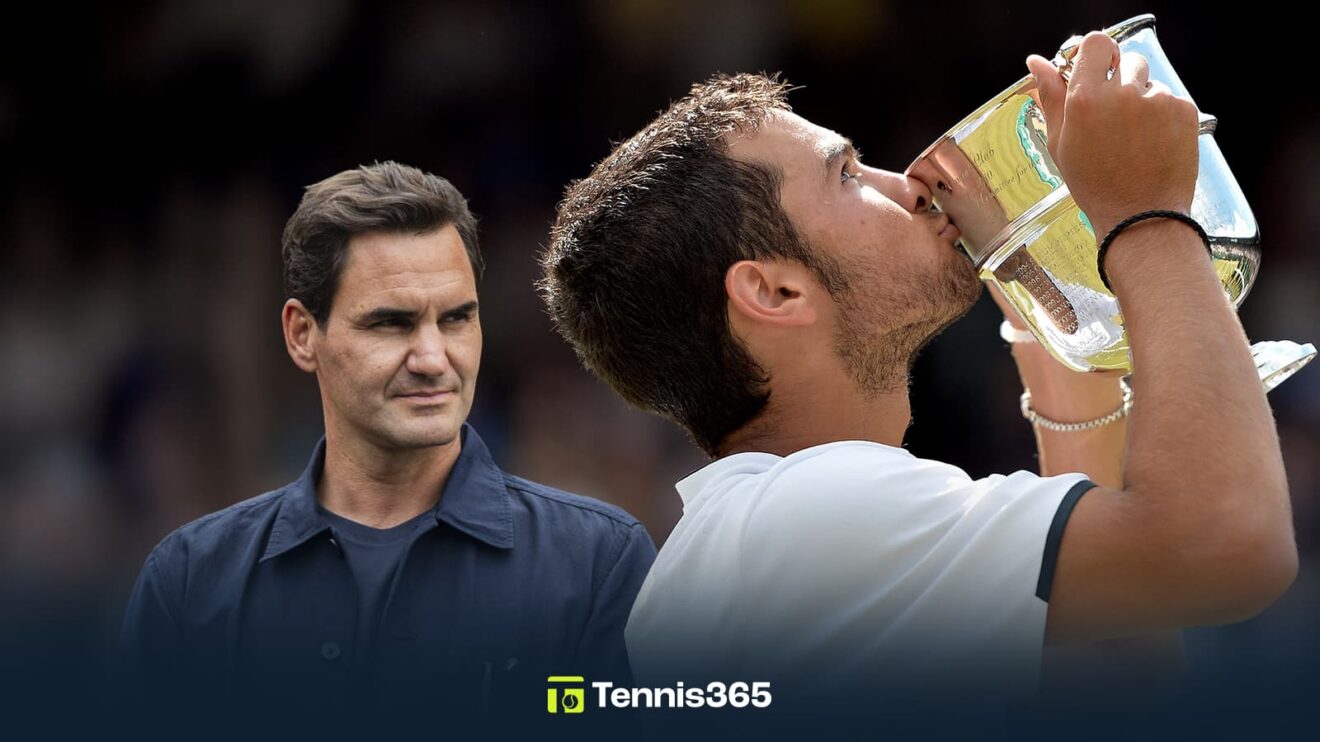
“It’s cool to play Wimbledon, but that’s four minutes out of the year. It’s easy to forget the countless nights by yourself, the times when you thought you were a failure.”
Noah Rubin looked to be the next great American prodigy. At the age of 15, John McEnroe hailed him as the “most talented player we’ve come across” at his Academy on Randall’s Island in Manhattan.
From there, the Long Island-born player became the No 1 junior in the United States, climbed to sixth in the world junior rankings, and won the 2014 Wimbledon Boys’ singles tournament aged 18.
“There was a decent amount of pressure. I don’t know if I felt it. I was playing pretty well, had a good junior career,” he told Tennis365. “I definitely felt the weight of New York.
“But it was that conversation of, ‘You’re not this 6ft 8in guy that’s taking it on’; I’m grinding through, I’m trying to hold my emotional standard to a very high level. And that correlated to being the face of the John McEnroe Tennis Academy.”
More Tennis News
Stan Wawrinka: Grand Slam rule change required as US Open and Wimbledon failures writ large
Roger Federer practises with former top 5 player ahead of US Open match
Want more from Tennis365? Add us as a preferred source on Google to your favourites list for tennis coverage you can trust.
That expectation grew when he beat Stefan Kozlov in front of 10,000 fans on No 1 Court at Wimbledon in the first all-American final since 1977. But it nearly almost never happened.
“Ironically I got to my career high ranking many years before I won junior Wimbledon and stopped playing junior tournaments pretty early on,” he said. “I kind of felt like I got what I could out of junior tennis. There wasn’t really much left for me to explore and then I had that really tough conversation of ‘Do we play pro, do we not?’
“Junior slams have this ‘professional exempt’ that allows you to play junior tournaments when you have a professional ranking. So honestly, one of the few compliments or things that I’ll put on to John McEnroe was he really forced my father and I to go out and play the Grand Slams at the end of my junior career, which we really didn’t want to do.
“And then after the French Open, I qualified, lost in the second round to Quentin Halys, the only other professional exempt at the time. And I said, ‘I’m not playing anymore. I’m definitely not going to Wimbledon’. And then John convinced us to go and I travelled to London 24 hours before my first round qualifying match. And obviously the rest is history.”
 A young Noah Rubin at the French Open
Did Rubin, who said winning junior Wimbledon was an “amazing” experience that “forever lasts with me”, have any axes to grind against former world No 1 and seven-time Grand Slam winner McEnroe?
The now 30-year-old replied, “No, it was just one of those things that he wasn’t my coach. I think throughout his career off the tour, he’s kind of learned how to portray messages differently and feel more comfortable explaining his thought process.
“I tried to get little titbits here and there when I could, because here’s a guy who has been part of the highest levels of tennis. And it’s really important just to take as much feedback as possible. But at the time, I think it was early on for him and I don’t think we necessarily meshed perfectly in a coaching situation.”
Life after Wimbledon triumph
A month after Wimbledon, Rubin swept aside all the competition to win the singles and doubles titles at the U.S. Tennis Association’s Boys 18s National Championships.
But instead of turning professional, the 5ft 9in player earned a scholarship at Wake Forest University in North Carolina, where part of his schedule included playing pro events – one of which included getting a wildcard at the 2014 US Open, where he lost in the first round to Federico Delbonis.
While College tennis in America is booming right now, the landscape was quite different when Rubin went.
This was before the 2021 Supreme Court ruling which imbued college athletes with a legal right to earn compensation for their personal brand – something that became known as NIL (Name, Image, and Likeness). Now, students can secure brand endorsements and social media promotions that lead to seven figure sums.
Rubin said, “I made the decision to go to college at that point in time, which wasn’t as popular because we didn’t have the NIL deals that we have today. It was brilliant to see how my career progressed through the juniors and I had a really good first year out on tour after my first year at Wake Forest University – which was a rollercoaster.
“My mum was a school teacher so I had career motives. I was one of the first tennis players to get this one year out rule where I still basically can go back at any time and finish my degree just in case anything went wrong.
“I almost wish I went for more years than I actually did. Now, we’re at this point where guys are getting paid more to play college tennis than they are to play professionally.”
The brutal reality of turning pro
 Noah Rubin on the ATP Tour
Rubin turned pro in June 2015 at the age of 19. Later that year, he won the Charlottesville Challenger, beating Tommy Paul in three tight sets. That allowed him to win the USTA Pro Circuit Australian Open Wild Card Challenge, and with it, he earned a wildcard at the 2016 Australian Open.
There, he knocked out 17th seed Benoit Paire, before falling in the second round. By that point, the relative safety net of college felt a long time ago.
“For expenses, we’re getting into $50-75,000 (£37-55,000) a year for travel, one-off massages, equipment; and that’s not really counting for having a coach and a physio with me and paying for their salaries,” said Rubin. “In my best year in 2018, that probably stretched towards the $200,000 (£147,000) range.
“I have friends that play soccer in the MLS and USL Championship and they get a salary, which can seem low, but they don’t have to pay for anything. There’s no expenses. I didn’t have any surgeries but I definitely had to pay for all the rehab which was really difficult.
“I’ve had some extremely helpful benefactors and I needed that. I broke my wrist, I had high ankle sprains, a minor fracture in my right ankle, and these kept me out for months. So to get from 1,000 in the world to 160 out of college and then to have an injury and fight back again from 350 – it was a massive effort.”
Rubin reached a career-high ranking of 125 in October 2018. By that point, he had won four Challengers in singles but already at the age of 22, he was feeling burnt out.
The American previously explained how he was “crying hysterically with the lights off” in a Spanish hotel after losing in the qualifying rounds of a lower-tier Challenger event that year.
“It’s funny now, I kind of romanticise tennis. You’re watching Wimbledon, one of my favourite events in Newport was on, the grass court season is such a special time for a lot of players,” he said.
“But then my wife likes to remind me, ‘This wasn’t it, right?’ Obviously there were some incredible moments and it opened so many doors but it’s so easy to forget the countless nights by yourself, the times where you thought you were a failure, where you’re not making any money, you’re on the road alone, and people are questioning why you’re doing it.
“It’s cool to play Wimbledon, but that’s four minutes out of the year. The Australian Open was my best Grand Slam and maybe I’m spending a week there but then there’s another 40 weeks to play; trying to bring that level of intensity, care, focus and love for the sport when there are so many reasons not to love the sport.
“When you’re in a random city and nobody’s watching and nobody cares and you just have to figure it out and make your way through. It took a lot out of me mentally and then fiscally, you have to have the conversation, ‘Can I afford this?’ And the answers were usually no.”
Facing Roger Federer
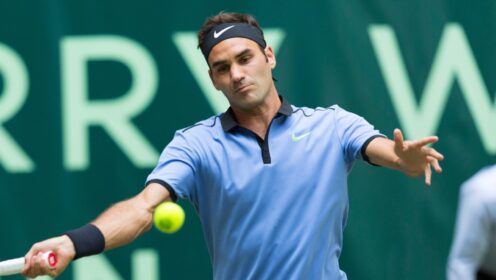
Before the real hardships kicked in, Rubin got the chance of a lifetime in the second round of the 2017 Australian Open as he faced the returning Roger Federer on Rod Laver Arena. After outlasting compatriot Bjorn Fratangelo in five sets, the then 20-year-old locked horns with the 17-time Grand Slam champion.
But rather than being overawed by the occasion, Rubin thrived in it. After going 7-5, 6-3 down to the Swiss, who was coming back after six months out with a knee injury, the youngster went a break up in the third set and then had two sets points when leading 5-2.
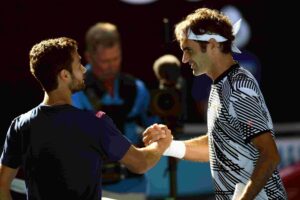 Noah Rubin shakes hands with Roger Federer at the Australian Open
“This is where everybody thought he was going to retire that year and he went on to have one of the best years of his career,” he said. “When you’re playing in front of 15,000 people against basically everybody’s idol who has ever played tennis, you’re like, ‘I’ll be out here for 45 hours if I have to!’
“Playing him is tough to put into words. When you see Federer in person, it’s like a hologram. I went 3-0 up in the third set and screamed, ‘Come on!’ And he kind of eyed me down. Those are the moments that I remember forever.
“Here’s this New York kid that had that little chip on my shoulder and got Roger Federer pissed. I pissed him off and gave him a real scare. If I cleaned up those set points, I would have felt confident going into a fourth. Those were the times to remember. This was obviously not a waste, I wouldn’t have traded it for anything.”
Federer roared back and took the set on a tiebreak but it was clear at the post-match handshake, Rubin had earned the veteran’s respect.
Would Noah Rubin do anything differently?
Rubin, who got to train with the likes of Novak Djokovic, Andy Murray and Rafael Nadal, earned just under £600,000 in his tennis career. He had made it to all the Grand Slams but it seemed his race was run.
By September 2022, Rubin announced he would be taking an indefinite break from professional tennis. Soon after, he tried his hand at pickleball, before returning to tennis and then retiring for good in 2024.
Among all the highs and the lows, would Rubin do it all again if he could?
“To some degree, I would actually say do it harder and earlier,” said the executive director of the Hudson River Tennis Club in Manhattan. “My first year went really well, then I got injured and it held me back. I didn’t even know what a protected ranking was at that point. So I wish I had a little bit more help on that end.
“But I just would have said, ‘You have five to seven years to put everything on the line’. I put a lot of effort in but we’re talking about inches. I would have said take that extra trip, do one more tournament, don’t go back home. I know you’re tired but just push through to do one more event.”
Rubin explained how he is on and off mentoring 18-year-old American Jack Kennedy, who is just inside the top 400, and trying to be a guiding light as he embarks on a pro career.
“He’s another short Long Island kid. There’s that conversation about listening to your grandpa, go to college, play a good year, see what happens,” he said. “I think I see a little bit more fire to put everything on the line than I potentially had.”
When reflecting on his career highlights, some might point to his wins over former top 10 players Marcos Baghdatis, Mikhail Youzhny and John Isner – the latter of which grabbed the headlines when Rubin’s shoe disintegrated at the 2018 Washington Open.
Facing Federer – who is about to be inducted into the International Tennis Hall of Fame – would have undoubtedly been another, along with his junior Wimbledon triumph. But sometimes, the little known moments are the ones that stay with him the longest.
“I don’t usually want to talk about the John Isner win because it is so overused with the broken shoe at this point,” he said. “Playing Roger was a highlight, playing on Court One at Wimbledon and having 10,000 people pay for tickets to watch me play while Novak [Djokovic] and Roger are playing on Centre Court.
“One that sticks with me was when Mitchell Krueger (a 32-year-old who is ranked just outside the top 350) and I were listening to music blaring on Rod Laver Arena while we were warming up.
“My coach at the time was Stanford Boster and I was having some help from former top 15 player Robby Ginepri. It was just like this surreal moment of, ‘Wow, look where tennis has taken me’.
“I have the stadium to myself, getting ready for a match against the greatest of all time (Federer). That’s kind of some of my most proud moments that weren’t even a part of any matches.”
READ MORE: Carlos Alcaraz breaks his silence about US Open comeback decision