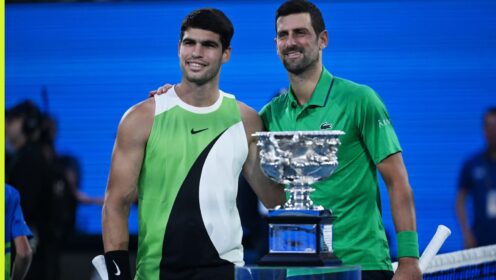
Novak Djokovic gives ‘gruelling and demanding’ response when asked if women should play five-set matches



As the debate around women playing five-set matches at Grand Slams continues, Novak Djokovic admits it’s a “whole different animal” than playing three-setters.
Former Australian Open Tournament Director Craig Tiley floated the idea of women playing best-of-five from the quarter-finals onwards at majors, but the suggestion has had mixed responses with the likes of Iga Swiatek and Elena Rybakina against it while reigning world No 1 Aryna Sabalenka believes she is up for the challenge.
24-time Grand Slam winner Djokovic has played nearly 500 best-of-five-set matches during his illustrious career so he knows the mental and physical toll of these lengthy matches.
His longest-ever five-setter was in the 2012 Australian Open final when he battled Rafael Nadal for five hours and 53 minutes before winning.
The Serbian’s most recent one was at this year’s season-opening Grand Slam at Melbourne Park as he took four hours and nine minutes to beat Jannik Sinner in the semi-final.
When asked about the idea, the former world No 1 replied: “I don’t recommend [it] (smiling).”
Tennis News
Female players ‘ready to handle five sets’ says WTA tour player as debate goes on
Iga Swiatek, Coco Gauff and Amanda Anisimova give their opinions on playing best-of-five sets
Djokovic was then asked to elaborate about the challenges and he explained: “It feels like when you’re preparing for a Grand Slam, you play best-of-five for us, it feels like you’re preparing for something completely different, completely different tour, different physical preparation and mental preparation.
“Because some matches can go, you know, three, four, five, six hours. And I have played, you know, the longest Grand Slam final in history. I was part of that with Nadal in 2012, went almost six hours in Australia.
“So just gruelling. I mean, incredibly gruelling and demanding, and I played recently with Jannik, I don’t know what it was, almost, whatever it was, four-and-a-half, almost five hours in Australia.
“I mean, back in 2012, my body had recovered much faster than what is the case today after such a marathon, long matches. Yes, you do have a day between matches in Grand Slams, but when you have a match like that, that is, you know, four-, five-plus hours, it’s just taking a big toll on your physical condition. Very hard to recover and be able to, I guess, be ready for the next challenge.
“You might play well the next match, but then the longer you progress in the tournament, the physically more exhausted you are. That’s the big one. Obviously mentally, as well, of course. But physically, it’s a whole different animal, so to say, that you’re facing in Grand Slams compared to anything else that we have on the tour.”