Novak Djokovic future addressed after US Open nightmare as Greg Rusedski reveals key issue


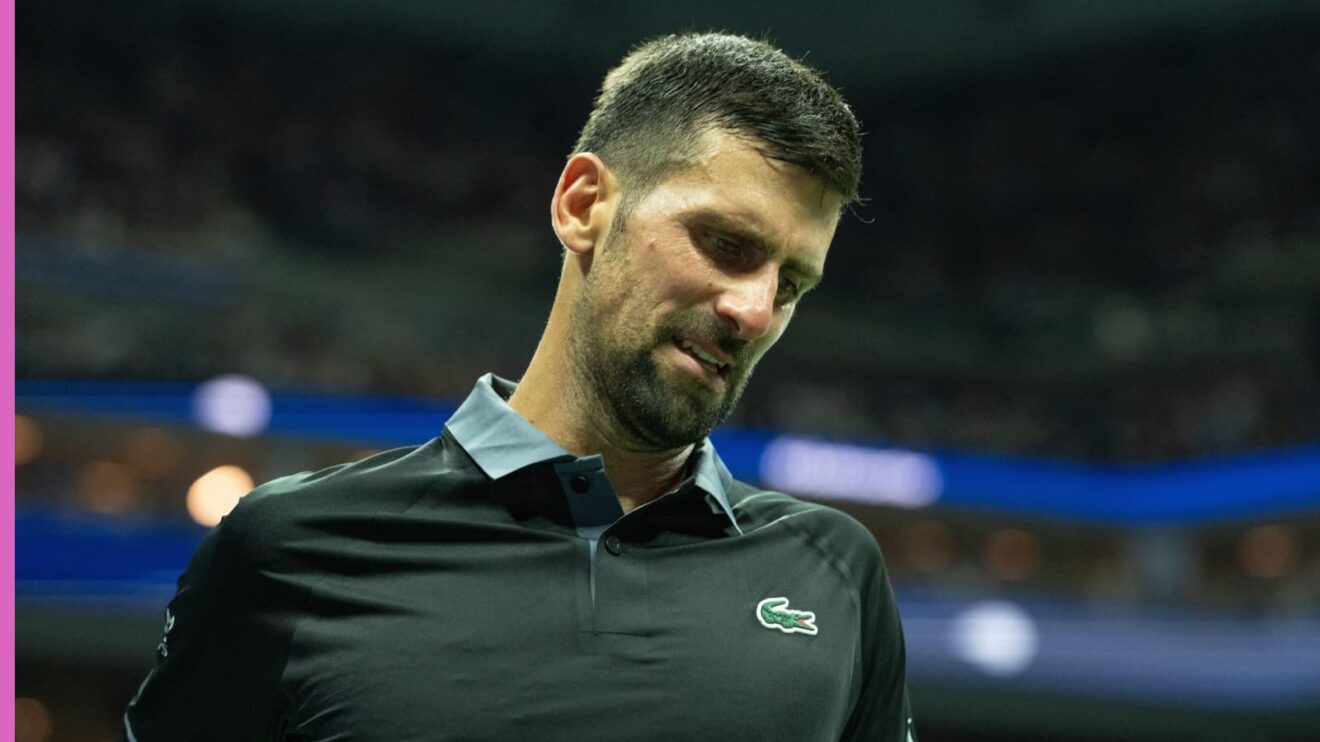
Greg Rusedski has called for people not to write off Novak Djokovic just yet despite him suffering his earliest Grand Slam exit in 20 years.
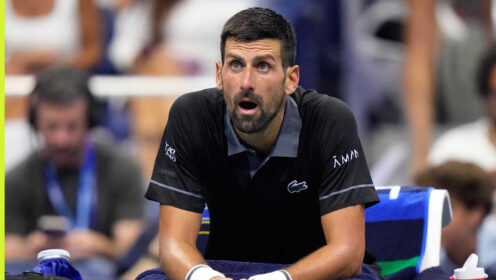
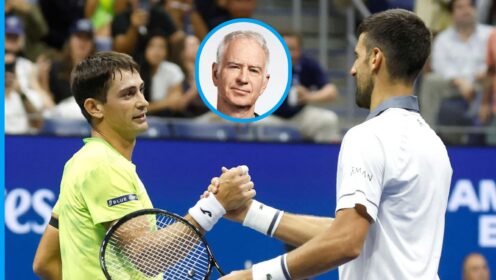
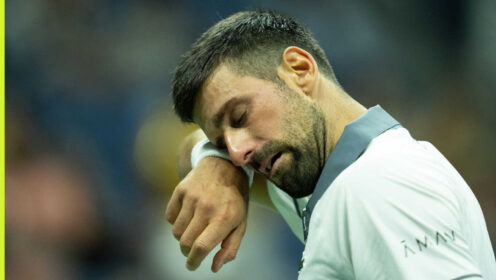
The 39-year-old lost in five sets to Mariano Navone on Sunday, as the Serbian fought back tears and threw up into a bin on Arthur Ashe Stadium as his body appeared to fail him.
The 24-time major champion was one of the favourites to win the US Open, particularly with world No 1 Jannik Sinner out injured and Carlos Alcaraz just returning from a wrist issue, but was outlasted by the Argentine 7-6 (7-5) 5-7 4-6 6-2 6-1.
After the match, the former world No 1 painted a rather downbeat picture for his future as he opened up on some ongoing health problems.
“I think it was obvious that it was an awful feeling for me on the court,” said the fourth seed. “It’s something that I’ve been carrying, unfortunately, pretty much every match this year: vomiting, throwing up, a serious issue there.
More US Open News
ATP Rankings: How many points did Novak Djokovic drop at US Open, how much prize money did he earn?
All 21 withdrawals from 2026 US Open as three-time Grand Slam finalist joins growing list
Want more from Tennis365? Add us as a preferred source on Google to your favourites list for tennis coverage you can trust.
“Then my whole body starts to collapse, cramping and pain. The back just gave up in the end, and shoulder, and I couldn’t close it out.”
Djokovic added, “I don’t know [how I can solve the problem]. I don’t want to go into too much detail right now. I’m just trying to understand what’s going on and how much longer I can keep going like this.”
Despite that, former British No 1 Rusedski was quick to point out that Djokovic reached the final of the Australian Open, beating Sinner along the way, and made it to the last four at Wimbledon.
Moreover, the fact that he has lost two matches in a row, one at Cincinnati and one at the US Open, should not spell doom and gloom for the Serbian.
He said on Off Court, “Well, we’ve only seen the deterioration really this US Open and in Cincinnati. Wimbledon, we didn’t see anything. He still made the semis. In the heat in Australia, he made the finals.
“So you’re talking about this deterioration. It’s all relative, isn’t it? It’s only been the last few weeks since Wimbledon. Most people’s careers would have been set up for life. Finals of Australia, semis of Wimbledon. That’s a pretty good season for most human beings. So let’s not write him off quite yet.
“And if the body still allows him to do what he needs out there, let’s keep him in the game as long as, as long as he can be there. So that’s the balance. Will he physically be able to sustain and will he be satisfied going out earlier at the very biggest events in the world? This is a little bit of a shock.
“It’s a bad draw for him as well, the opening round. We talked about it in the lead up to the US Open saying he was in a tough section and we all knew he had a difficult opener, especially having had no form from Cincinnati and losing early.”
However, former US Open finalist Rusedski does believe that Djokovic’s part-time schedule could be an issue. Conversely, though, the former world No 4 pointed out that Serbian may need to limit the number of tournament he enters to allow him to go deep at majors.
As he put it, it is something of a “chicken and egg” issue. One thing that doesn’t help, though, is how “brutal” the competition is among the world’s top 100.
“I think the issue is, two out of three sets, no problem. But if you look at his preparation, he’s not being able to get enough matches. And you know, when [Roger] Federer was at his peak, he played 12 tournaments a year, but he’d win seven of those tournaments. Novak nowadays, the depth is a lot stronger,” he said.
“So if you look like from say three to 20, it’s probably slightly weaker, but then you go from 10 to 100 and the depth is brutal. So from the first round, you’ve got to show up. If you’re not at your best from the beginning, it makes life much more difficult.
“The question for me is, if he plays more two out of three set tournaments, that’s going to get him great preparation for the slams. So it’s a chicken and egg. Will the body allow him to play those matches and those tournaments?
“So let’s see if he can get it back. And as he said, if he plays two or three set matches, there’s still tournaments he can win and he can still win more events. And he still loves the love he’s getting from the fans.”