Daniil Medvedev explains why Carlos Alcaraz & Jannik Sinner are dominating – and names their closest rival


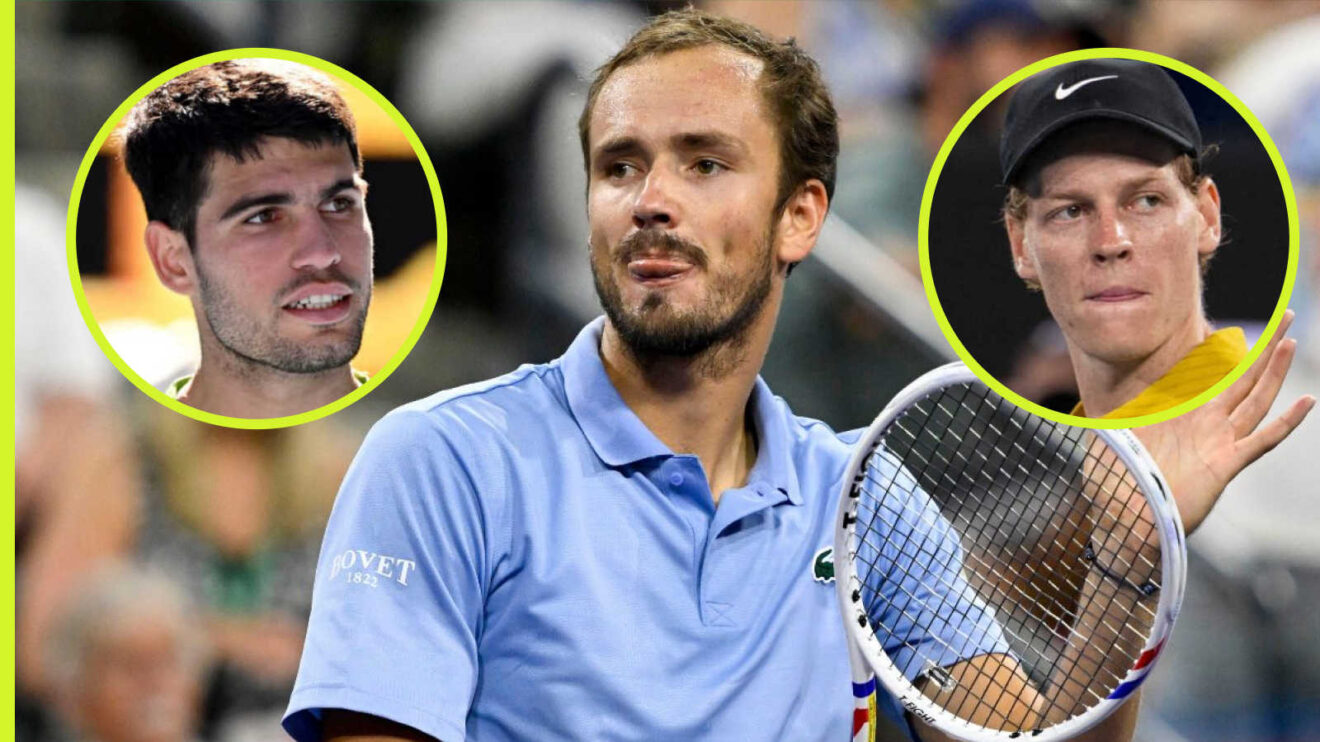
Daniil Medvedev has revealed why Jannik Sinner and Carlos Alcaraz have dominated tennis over the past 18 months, and responded to claims that he is part of a ‘lost generation’.
The pair have transformed the landscape of men’s tennis since the start of the 2024 season, winning all nine of the most recent Grand Slams.
Last season, they contested the showpiece match at the French Open, Wimbledon, and the US Open – a feat not achieved by Rafael Nadal, Roger Federer, and Novak Djokovic within their respective rivalries.
World No 2 Alcaraz holds a remarkable 7,705-point lead over world No 3 Alexander Zverev in the ATP Rankings, while the Italian leads the Spaniard by 390 points.
Most recently, the duo faced off in the final of the Monte-Carlo Masters – their first clash of 2026 – with Sinner victorious, 7-6(5), 6-3.
It marked Sinner’s fourth consecutive Masters 1000 title, having previously triumphed in Paris, Indian Wells, and Miami.
Medvedev, currently ranked world No 10, was recently asked by ABC what separates Alcaraz and Sinner from the rest of the field.
Latest Tennis News
Tennis experts reveal why Novak Djokovic, not Jannik Sinner, benefits most from Carlos Alcaraz’s French Open withdrawal
‘There’s one who might not be disappointed by Alcaraz’s French Open absence, and that’s Djokovic’
“Their [Alcaraz and Sinner] strength lies in the fact that they almost always play at their best, even if they don’t always show it,” the Russian analysed during his interview.
“But that means that when they do drop their level, it’s only slightly lower,” he said.
“And that’s why they beat everyone. In my case, on the other hand, my level fluctuates more. So I hope to find my best form again and try to beat them.
“They’re very far ahead of everyone right now.
“Perhaps in terms of consistency, Zverev might be a little closer. And that’s why he’s ranked third in the world. But even so, it’s difficult for him to beat them.
“And they’re still there at the top. So, for now, the difference is enormous.”
While both Sinner and Alcaraz have enjoyed significant success, they are also constantly refining their games.
After a poor performance in the US Open final – where he made just 48% of first serves – the Italian went straight to the practice courts to find a solution.
Sinner, in collaboration with coaches Darren Cahill and Simone Vagnozzi, developed a more left-leaning ball toss and a slower, more rhythmic service motion.
The change was highly-effective as, prior to the clay-court season, he had held 422 out of 450 service games and won 11 of the 12 tiebreaks he contested.
Similarly, Alcaraz arrived at the Australian Open with a modified service motion – one that drew comparisons to Djokovic’s.
Medvedev believes that this ability to adapt and evolve makes the pair more unpredictable to face.
“Sinner has improved his serve a lot now,” analysed the Russian.
“It’s very difficult to counter. With Carlos, it’s more the power of his shots, the power of his forehand. And suddenly, bam, he hits a drop shot.”
“And it’s not just that, because with power, you never know what to expect. Drop shots are fantastic, and even if you anticipate them, you’re not sure you’ll win the point; they’re incredibly fast.
“Basically, they have every shot in their repertoire. And most of them can be better than yours. So it’s not easy to defend against.”
Medvedev, born in 1996, is considered part of the so-called ‘lost generation’, a group of players who were unable to establish sustained dominance on tour.
More specifically, players born in the 1980s collected a total of 80 singles Grand Slam titles, while those born in the following decade have claimed just two (Medvedev and Dominic Thiem).
Sinner and Alcaraz, both born in the 2000s, have already won a combined 11 Grand Slams and have firmly left their mark on tennis history.
“That’s just the way it is,” added the former world No. 1.
“In our generation we didn’t have a player of the calibre of the Big 3, or the one that Carlos and Jannik have now. They play better, they’re stronger, more consistent, faster. So it’s not a problem to be worse than them.
“Just as it wasn’t a problem to be worse than Nadal, Federer and Djokovic. At that time, Wawrinka won three Grand Slams; Cilic one, and Murray won three. And then Thiem came along and I won one too. Anyone else? No, no one else.
“That’s the way it is. We don’t have a player who’s going to win 15 Grand Slams and play the best tennis of his life day in and day out.
“But we have some amazing players who can still win a Grand Slam, at least win a lot of big tournaments.”